You don't need to become a technologist to make good decisions about AI for business. You need a clear-eyed picture of what it is, what it can actually do for an organization like yours, and where the honest opportunities sit. That's what this guide gives you — in plain English, with no AI-as-magic.
I'm Kate, and I spend my days helping small businesses and nonprofits put AI to work without losing the human judgment that makes their organizations worth running. Most of what's written about AI is either breathless hype or fog, and neither helps a leader decide what to do on Monday morning.
Here's the promise: by the end, you'll know what AI is, what it isn't, and three honest places to look in your own business. No jargon without translation. No pressure to spend a dollar.
1. What 'AI' actually means today (and the parts you can ignore)
When people say "AI" right now, they almost always mean one specific thing: large language models — the technology behind tools like ChatGPT, Claude, and Copilot. These are systems trained on enormous amounts of text and images so they can recognize patterns and produce something useful: a draft email, a summary of a long report, an answer to a question, a first pass at a spreadsheet formula. That's the part that matters for most organizations today.
You can safely set the rest of the vocabulary aside for now. Neural networks, transformers, parameters, GPUs — that's how the engine is built, not how you drive it. You don't need to understand a transmission to decide whether a car fits your business. The same is true here. Treat AI as a capable but literal new teammate: fast, tireless, widely read, and in need of clear instructions and a second set of eyes.
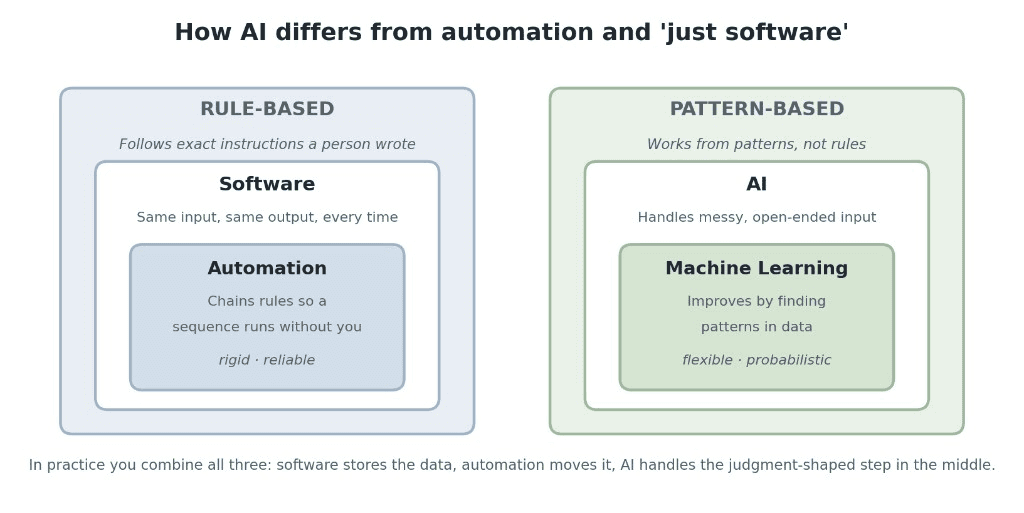
One distinction is worth keeping, because we'll use it later. AI is the broad idea of machines doing things that used to require human thinking. Machine learning is one method for getting there — software that improves by finding patterns in data rather than following rules a person wrote line by line. The chat tools you've heard about are built on it. Hold that thought; it makes the next sections clearer.
2. What AI can reliably do for an organization right now
Here's the honest list — the things AI does well enough today that you can lean on them:
- Draft and revise. First drafts of emails, proposals, job descriptions, grant narratives, social posts. It won't nail your voice on the first try, but it gets you to "editing" instead of "blank page."
- Summarize and find. Condense a 40-page report into a page, pull the three action items out of a meeting transcript, or search across your own documents for the answer you half-remember.
- Translate and explain. Turn a dense contract into plain language, translate marketing copy, or explain an unfamiliar concept at exactly the level you ask for.
- Sort and tag. Route incoming emails, categorize support tickets, flag which customer notes mention a refund.
- Surface patterns. Look across your sales or client data and pull out common themes you can actually act on.
The U.S. Small Business Administration points to the same kinds of wins — saving time on repetitive work, making sense of your own data, and staying competitive without adding headcount (SBA). These aren't speculative. A motivated owner can test most of them this week, often with free or low-cost tools.
3. What AI can't do (and what that means for you)
This is the part the hype skips, and it's the part that protects you.
AI doesn't know what's true. It predicts what a good answer looks like, which means it can state something wrong with complete confidence. Practitioners call this a "hallucination." Anything headed to a client, a funder, or a regulator needs a human to check it.
AI doesn't understand your context unless you give it. It hasn't sat in your board meetings or met your customers. It knows the world in general, not your organization in particular.
AI doesn't own the outcome. It can recommend; it can't be accountable. Judgment, ethics, and responsibility stay with people — yours.
What this means is simple and freeing: AI is a teammate, not a replacement, and definitely not an oracle. The organizations that get value from it keep a person in the loop at the seams — the points where the work hands off to a customer, a decision, or a dollar. That's not a limitation to apologize for. It's the design.
4. How AI is different from automation and 'just software'
This is where a lot of confusion lives, so let's draw clean lines.
Regular software follows exact rules a person wrote. Click the button, get the report. It does the same thing every time and can't handle anything it wasn't programmed for.
Automation workflows chain those rules together so a sequence runs without you — when a form is submitted, send the email, update the spreadsheet, notify the team. Powerful, reliable, and still completely rule-bound.
AI is different in kind. Instead of following rules, it works from patterns, which lets it handle messy, open-ended input — a question phrased five different ways, a document it's never seen, a request to "make this friendlier." It's flexible where software is rigid. The trade-off: it's probabilistic, giving you a likely answer rather than a guaranteed one. That's exactly why the human check from the last section matters.
5. Three honest places AI could touch your business this quarter
You don't need a strategy to start learning — you need one or two real tasks. Here are three places most SMBs and nonprofits find an early, low-risk win:
- The communications pile. Routine emails, newsletters, donor updates, proposals, and posts. Low stakes, high volume, easy to keep a human editor in the loop.
- The reading you never get to. Long reports, contracts, applications, or meeting recordings — summarized so you act on them instead of avoiding them.
- The repetitive sorting. Categorizing tickets, tagging inquiries, organizing notes — the small, recurring tasks that quietly eat your team's hours.
Notice what these share: the cost of a mistake is low, a person reviews the result, and you'd feel the time savings immediately. That's the profile of a good first project.
| Task | Good first project? | Why |
|---|---|---|
| Drafting routine emails & posts | Yes | High volume, low stakes, easy to keep a human editor |
| Summarizing long reports & calls | Yes | Saves real time; a person still verifies the takeaways |
| Sorting tickets & tagging inquiries | Yes | Repetitive, rule-light, immediate hours back |
| Final answers to clients or funders | Not yet | Mistakes are costly — keep a person accountable here |
| Decisions involving sensitive data | Not yet | Vet the tool and set a data policy first |
6. What to do before you spend a dollar on AI
The most expensive AI mistakes happen when leaders buy a tool before they understand the problem. A deliberate path costs less and works better:
- Start with the work, not the tool. Name one task that's slow, repetitive, or perpetually behind. The technology is the last question, not the first.
- Check your data and your rules. Is the information AI would need actually written down somewhere? Do you have a simple rule for who reviews the output before it leaves the building?
- Run a small, real test. Pick one task, try it for two weeks, and compare honestly. You'll learn more from one real attempt than a month of demos.
- Mind trust and privacy. Don't paste client, donor, or employee data into tools you haven't vetted. Decide what's allowed before anyone starts.
- Keep a human at every seam. Wherever the work touches a customer, a decision, or a dollar, a person stays accountable.
Here's the reassuring part, from the people studying this at scale. PwC's 2026 analysis found that technology delivers only about 20% of an AI initiative's value — the other 80% comes from redesigning how the work flows around it (PwC). And even large enterprises haven't settled who should own AI; MIT Sloan reports only 38% have appointed a chief AI officer (MIT Sloan). Translation: nobody has this fully figured out, the advantage goes to leaders who are thoughtful rather than fast, and your human-centered instincts are an asset here — not a handicap.
7. FAQ: AI for business, in plain English
What is AI for business?
In plain terms, AI for business means using tools built on large language models — like ChatGPT, Claude, or Copilot — to handle language- and pattern-heavy work: drafting, summarizing, sorting, and surfacing themes in your own data. For most SMBs and nonprofits today, that's the whole game.
Do I need technical staff to use AI?
No. Today's tools are built for non-technical users — you describe what you want in plain language. You need judgment and a willingness to experiment, not a computer science degree.
Is AI safe for sensitive data?
It can be, but not by default. Use business-tier tools with clear data policies, and never paste confidential information into a free consumer tool you haven't vetted.
Will AI replace my team?
It's far better understood as a teammate that handles the repetitive parts so your people spend more time on judgment, relationships, and the work only humans can do.
How much does it cost to start?
Often very little. Many capable tools have free or low-cost tiers — which is exactly why a small, real test beats a big purchase.
How do I know if I'm ready?
Start with one slow or repetitive task and one honest two-week test. If you'd like a structured way to gauge it, the AI Readiness Self-Assessment is built for that.
Your one action this week
List three places AI could realistically touch your business this quarter. Then pick the one with the lowest risk and the most obvious time savings — that's your first project.