The word "AI" is doing far too much work right now. It gets stuck on a chatbot, a fraud alert, a self-checkout camera, and a sales forecast — four genuinely different tools wearing one label. That blur is what makes vendor calls confusing and budgets risky. So here's a field guide: the five types of AI for business worth knowing, sorted not by how they're built but by the job they do.
The point of this map isn't to make you technical. It's to let you hear "AI" in a meeting and immediately ask: which kind, and what job are we hiring it for?
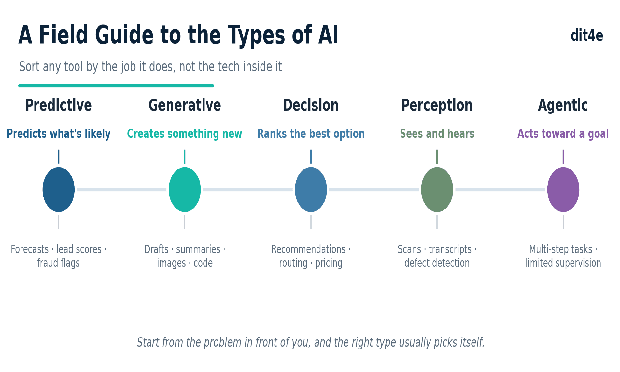
1. Predictive AI
What it does: learns from past data to predict or classify. It answers "what's likely?" — how much we'll sell next month, which lead is worth a call, whether a transaction looks like fraud. This is the quiet workhorse (often called machine learning for business) that's run behind the scenes for years.
Use it when you have history and want a head start on what comes next. The catch: it's only as good as the data it learned from, so a person owns the judgment call at the seam.
2. Generative AI
What it does: creates something new from a prompt — text, images, code. It's the kind everyone's talking about (ChatGPT, Claude, Copilot), and for most small businesses and nonprofits it's the most useful today because it tackles the language-heavy work that eats your week in the generative AI vs. traditional AI vs. automation conversation.
Use it when you need a fast first draft or a quick summary. The catch: it can be fluently, confidently wrong, so every output gets a human edit before it leaves the building.
3. Decision and recommendation AI
What it does: recommends the next best option from many. It's the engine behind "customers also bought," route optimization, dynamic pricing, and inventory suggestions — less about predicting one number, more about ranking choices and nudging an action.
Use it when you're drowning in options and want the strongest few surfaced. The catch: it optimizes for whatever goal you set, so set the goal deliberately — the wrong target produces confident, unhelpful advice.
4. Perception AI (vision and voice)
What it does: turns the physical world into data it can read — images, video, speech. Think scanning an invoice, transcribing a call, reading a receipt, or flagging a defect on a line. It's how AI "sees" and "hears."
Use it when the work starts as a photo, a scan, or a recording and you want it as searchable, usable text. The catch: accuracy drops on messy real-world inputs, so keep a human spot-check where mistakes are costly.
5. Agentic AI (and why people are talking about it)
What it does: takes a goal and carries it through in steps — using tools, calling systems, and making intermediate choices with limited supervision. It isn't a separate intelligence so much as generative AI given the ability to act, not just answer.
This is the layer I spend most of my days in — I helped build an AI orchestration layer — so I read Deloitte's 2026 State of AI report with a particular eye. One number stopped me: 85% of companies expect to customize AI agents, but only 21% say they have a mature way to govern them (Deloitte). Read that as a practical warning, not a statistic — most organizations are turning agents loose faster than they're deciding who's accountable when one acts. For a smaller organization the lesson is actually reassuring: you don't need an enterprise governance program, you need one clear rule about which steps an agent may take on its own and which need a human's yes before money, data, or a customer is touched. Start there. We go deeper in Agentic AI for Business: What Leaders Need to Know About AI Agents.
How to use this map
Notice the throughline: each type is defined by the job it does, not the technology inside it. Predict what's next, create something new, recommend the best option, perceive the physical world, or act toward a goal. Start from the problem in front of you and the right category usually picks itself.
When I read BCG's 2026 AI Radar, one line did more for my clients than any tool demo: only about 10% of AI's value comes from the algorithm, 20% from data and technology, and a full 70% from people and process (BCG). Sit with that for a second. It means the category you pick — the whole point of this guide — is the small slice; the real return comes from redesigning how the work flows around the tool and bringing your people with you. So use this map to choose well, then spend most of your energy on the 70%. If you're still getting oriented, start with AI for Business: A Plain-English Guide for Leaders.
Your one action this week
Take one real problem on your plate and match it to the AI type that fits: predict, create, recommend, perceive, or act. Naming the type is the first step to scoping a sane first project.