Sit through three vendor pitches and you'll hear the same two letters in all of them: AI. The trouble is they rarely mean the same thing. One vendor is selling a prediction model, the next a chatbot, the third a glorified set of if-this-then-that rules — all wearing the same label. Knowing generative AI vs automation (and where traditional AI fits) is what lets you ask the right questions instead of nodding along.
Here's the promise: by the end, you'll be able to spot which kind of "AI" a vendor is really selling you — without becoming an engineer. Three plain definitions, one comparison table, and a 30-second test.
1. Traditional AI: pattern-finders that predict and classify
Traditional AI — often called machine learning — learns from past data to make a prediction or sort things into categories. It doesn't create anything new; it answers narrow questions like "how many units will we sell next month?", "which of these leads is most likely to buy?", or "is this transaction unusual?"
This is the quiet workhorse that's been running behind the scenes for years — your spam filter, your credit-card fraud alert, the "customers also bought" suggestion. It's powerful and proven. The catch: it's only as good as the data it learned from. Feed it skewed or stale data and it makes confident, biased predictions — and the drift is easy to miss until a decision goes sideways. A person still owns the judgment call at the seam.
2. Generative AI: tools that create text, images, and code
Generative AI is the kind everyone's talking about — the technology behind ChatGPT, Claude, and Copilot. Instead of predicting a number or a category, it produces something new: a draft email, a summary, an image, a block of code. You give it a prompt in plain language, and it generates a response.
For most small businesses and nonprofits, this is the most useful kind today, because it tackles the language- and pattern-heavy work that eats your week. But it shares traditional AI's blind spot in a sharper form: it predicts what a good answer looks like, which means it can be fluently, confidently wrong. Treat it as a fast, well-read teammate whose first draft always gets a human edit before it leaves the building.
A note on agentic AI. You'll increasingly hear about "AI agents" or agentic AI. It isn't a separate kind — it's generative AI given the ability to act, not just answer: take a goal, break it into steps, use other tools, and carry a task through with limited supervision. AI agents are genuinely useful, and they raise the stakes on keeping a human accountable at the seams.
3. Automation: scripted, rule-based, and not actually 'AI'
Automation is the one most often mislabeled. It follows exact rules a person wrote: when this happens, do that. Submit a form, and it sends the confirmation email, updates the spreadsheet, and notifies the team — every time, the same way.
That reliability is the whole point, and it's genuinely valuable. But it isn't intelligence. Automation can't handle anything it wasn't explicitly told to handle; the moment reality doesn't match the rule, it breaks or does the wrong thing confidently. If a vendor calls a fixed workflow "AI," that's a flag worth noting — you're buying rules, not learning. In practice the best setups combine all three: automation moves the work, AI handles the judgment-shaped step, and a person stays accountable where it matters.
4. A 30-second test: which one is the vendor selling?
Next time someone pitches you "AI," ask three quick questions:
- Does it create something new from a prompt? → Generative AI.
- Does it predict or sort based on past data? → Traditional AI.
- Does it just follow fixed rules someone set up? → Automation (useful, but not AI).
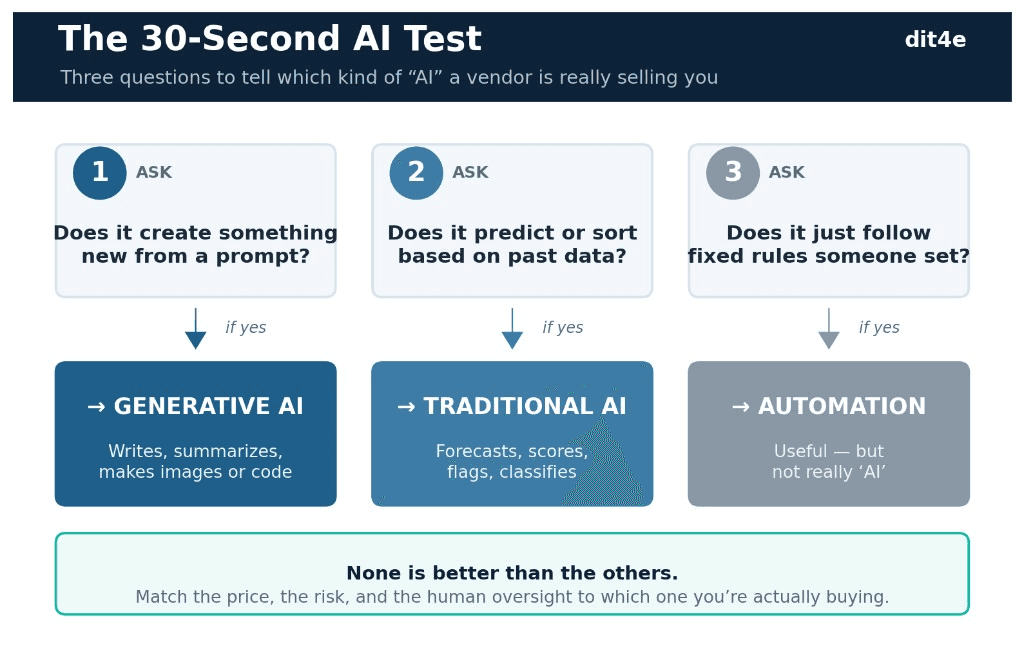
None of these is better than the others — they solve different problems, and the right answer depends on the job you're trying to do. What matters is knowing which one you're actually buying, so the price, the risks, and the human oversight all match reality. The table below is your cheat sheet.
| Type | What it is | Example use | Risk to watch |
|---|---|---|---|
| Traditional AI | Pattern-finders that predict or classify from data | Forecasting demand, scoring leads, flagging unusual transactions | Only as good as its data — bias and drift creep in quietly |
| Generative AI | Tools that create text, images, or code from a prompt | Drafting emails, summarizing reports, first-pass copy | Confident wrong answers — every output needs a human check |
| Automation | Scripted, rule-based steps — not actually 'AI' | "When a form is submitted, send the email and update the sheet" | Brittle — breaks the moment reality doesn't match the rule |
If you're still getting your bearings, start with our plain-English overview, AI for Business: A Plain-English Guide for Leaders.
Your one action this week
Pick two tools you already call "AI" and label each one: generative AI, traditional AI, or just automation. You'll be surprised how often it's the third.